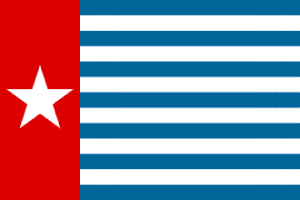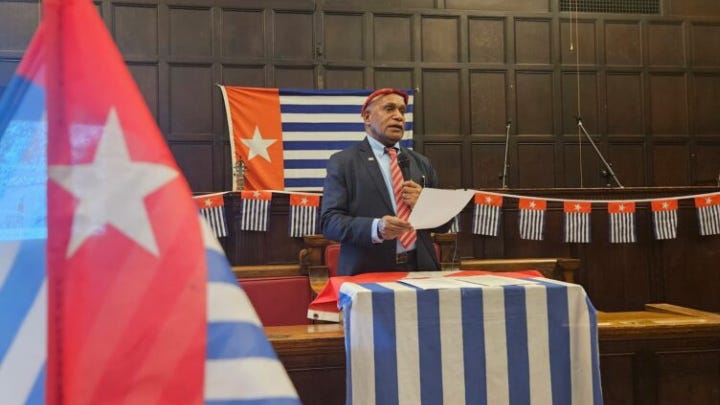
The UN Human Rights Council voted UN Permanent Representative of Indonesia Sidharto Reza Suryodipuro to serve as president of the UNHRC for the 2026 one year term on 8 January.
But West Papuan provisional government president Benny Wenda has cried foul on the appointment, questioning how Jakarta can lead on rights while occupying West Papua and genociding its people.
The disconnect in having the Asian nation of Indonesia heading the UNHRC, as it actively occupies the Melanesian territory of the West Papuan people, was heightened in October 2024, when Prabowo Subianto was voted in as president, as the notorious Suharto-era general was blacklisted from Australia and the US at the turn of the century, due to his deplorable human rights record.
Prabowo, however, is just one man, while the nation of Indonesia has been dubiously occupying West Papua since 1963, after the UN gifted it temporary administration, and ever since the 1969 UN-brokered vote on West Papuan self-determination resulted in a decision to remain with Indonesia, due to Jakarta’s standover tactics, the occupation of West Papua has been straight out illegitimate.
The UNHRC has a rotating membership, so a new president is elected every year for a year, and appointment to the role does not reflect an assessment of a nation’s human rights record. However, the body is the main authority on human rights globally and its decisions hold weight, so having a representative from a nation perpetrating a slow genocide is necessarily corrosive.
The further point to be made about the situation is that over the past five years the West Papuan nation has established a provisional government both in exile and on the ground in the Melanesian region, whilst it’s further handed a petition to the United Nations, calling for a fresh vote on self-determination. So, the West Papuan nation is more than ready to depart Indonesia.
“Indonesia should be a global pariah”
“How can Indonesia lead on human rights, when they are hiding from the world their 60 year occupation of West Papua, with five hundred thousand men, women and children dead?” asked West Papuan provisional president Benny Wenda.
“How can Indonesia lead on human rights, when their president is a war criminal who is complicit in genocide in East Timor and West Papua?”
“Prabowo personally tortured East Timorese men and presided over indiscriminate massacres of Indigenous people from Kraras to Mapenduma,” continued Wenda, who’s lived in exile in Oxford in the UK for the past two decades. “He has never apologised or been held accountable for his crimes.”
Wenda added that even with the UNHRC presidency being a rotating position not predicated on a nation’s record, it makes a mockery of the United Nations claim that it upholds international law, when Indonesia has been appointed regardless of its sketchy rights record, which includes the fact that 105,000 West Papuans are currently displaced due to recent Indonesian military operations.
Under Prabowo, the Indonesian human rights minister is Natalius Pigai, who is a West Papuan man. Pigia has publicly stated that in this UN role, Jakarta plans to counter breaches of international law, such as the kidnapping of the Venezuelan president by the US. But Wenda questions why Pigai is talking about rights violations elsewhere, when the state he works for is occupying his own people.
“Every single day for the past 63 years, West Papuans have suffered breaches of international law,” Wenda underscored. “There is no democracy in West Papua. We have no rights as Indigenous people, as Black people, as Christians.”
The Act of No Choice
As colonisers the Netherlands were set to vacate West Papua, the 1962 New York Agreement was struck. It involved the United Nations briefly administrating the Melanesian country, prior to Jakarta taking control on 1 May 1963, and this was predicated on the West Papuan people eventually having a referendum on whether to remain with Indonesian rule or to become an independent nation.
The UN-brokered Act of Free Choice was held in 1969. The so-called national referendum involved the Indonesian military rounding up 1,026 West Papuan men and by gunpoint, having them all vote that their nation remain under Indonesian rule. The West Papuans refer to this as the Act of No Choice.
Jakarta has since split the West Papuan region into two provinces not recognised by the local people, and more recently this has been upped to five separate provinces. A transmigration program was established in the 1970s, which has left West Papuans making up less than 50 percent of the people in the region. This program has recently been revamped under Prabowo.
The number of displaced people in West Papua has been rising since 2018, when the then Jokowi government began attacking villages in the highlands, with the initial assaults in the Nduga regency. The displaced people are the people from villages fleeing aerial attacks. The ongoing attacks were first sparked by disagreement over the construction of the Trans-Papua Highway.
There are grievances about the Trans-Papua Highway being rolled out through pristine Melanesian forest, but the destruction of the environment doesn’t stop there. Under Prabowo, one of the world’s largest deforestation projects is underway in the Merauke district of South Papua province. Eventually, 2 million hectares will be destroyed to make way for sugarcane.
An independent West Papua
As chair of the United Liberation Movement for West Papua (ULMWP), Wenda presented then UN High Commissioner for Human Rights Michelle Bachelet with the West Papuan People’s Petition in January 2019. This calls for the holding of a legitimate referendum on self-determination, and it contains more than 1.8 million West Papuan signatures, or 70 percent of the Indigenous populace.
The compiling of the signatures had to be done clandestinely under the oppressive and overbearing militarised rule of Indonesia in occupied West Papua.
Wenda announced the formation of the provisional government in January 2021, and by May that year, it had established itself on the ground, with 12 government departments, with the environmental department charged with progressing the West Papuan policy to establish the planet’s first green state.
The West Papuan Legislative Council had its inaugural meeting in Jayapura on 5 July 2025, which was hailed as the “rebirth of the West Papuan state”.
“Every single day for the past 63 years, West Papuans have suffered breaches of international law,” Wenda continued, in the wake of the announcement of Indonesia heading the UNHRC. “Every time Indonesia launches a new plantation or mine on occupied territory, the human rights of nearly 2 million Indigenous Papuans are violated.”
“Until the world intervenes to stop such egregious hypocrisy, until West Papua is recognised as a place of ongoing occupation, apartheid and genocide, there will be no peace or justice in the Pacific,” the West Papuan independence leader said in ending.
“The ULMWP continues to demand that Indonesia opens West Papua to journalists and allows a UN visit to the territory.”